Tuesday, June 16, 2026

Books 16 and 17: Franny, Zooey, and The Way of a Pilgrim

J.D. Salinger, author of the controversial Catcher in the Rye, also wrote Franny and Zooey, which had been sitting in my to be read pile for decades -- always near my nightstand but never on top. Written in the fifties and published together, Franny is a short story and Zooey is a novella and they read like two parts of the same book. In Franny, the reader has a front row seat to a dinner conversation between college coed Franny Glass and her boyfriend Lane. It is a painful view of her experiencing a nervous breakdown as she tells Lane about a book she's been reading. Zooey picks up where Franny leaves off, with Zooey, Franny's older brother, trying to help her even though he has troubles of his own. The reader is again ringside for a philosophical discussion, this time between the siblings in the New York City apartment. 

Maybe this is the book that started it all. After college, I lived with my great-aunt Nell in the small town of Tallassee, Alabama. She and I had some grand adventures while I did a lot of reading - and saved my money to move to Washington, DC. Years later, she asked me, "Jeannie, how many years did you live with me?" I answered, "Aunt Nell, that was six months." Oh how we laughed! (This has been mentioned before, read it here)

I must have read Franny and Zooey during that time, because some of the scenes remain vivid in my mind, tied inextricably with the scent of the large magnolia in Aunt Nell's front yard, the deeply, unnervingly quiet evenings, and the road to town that curved past the well-kept cemetery. Memories of the little book left enough of an impression on me to want to read it again, especially with the prayer, "Lord Jesus Christ, have mercy on me." It seemed like a good addition to this list of spiritual books. 

Franny's breakdown arises because of the dichotomy between her very superficial life and the wanderer in a book called The Way of a Pilgrim. I didn't remember the ties between books and enjoyed discovering this second book. It's about an unnamed Russian peasant from the 1800's who hears the words, "Pray without ceasing." He writes, "I looked at my Bible and with my own eyes read the words which I had heard, that is, that we ought always, at all times and in all places, to pray with uplifted hands. I thought and thought, but knew not what to make of it. 'What ought I do?'"

As simple as this pilgrim's life is, his story is fascinating; the life and times of a Russian peasant, his single-minded pursuit, and the people he meets along the way held my constant attention. And strangely enough, the pilgrim does the same thing Franny does; he refers to another book, The Philokalia, which he holds as dear to him as Franny does The Way of a Pilgrim. We can only assume Salinger copied this book-within-a-book on purpose.

Some favorite quotes: "After no great lapse of time I had the feeling that the prayer had, so to speak, by its own action passed from my lips to my heart." "All my ideas were quite calmed of their own accord. I thought of nothing whatever but my prayer. My mind tended to listen to it, and my heart began of itself to feel at times a certain warmth and pleasure." "Again I started off on my wanderings. But now I did not walk along as before, filled with care. The calling upon the name of Jesus Christ gladdened my way." "Know this, that all those troubles were warded off from you by the protection of the most holy Mother of God because of that short prayer, by which you lifted up your heart every day unto union with God." 

Meanwhile, over a meal (that she doesn't take a single bite of), Franny describes The Way of the Pilgrim and the Jesus Prayer to Lane. She says, "I mean all these really advanced and absolutely unbogus religious persons that keep telling you if you repeat the name of God incessantly, something happens." When Lane asks her, "What is the result?" Franny's answer is perfection. "You get to see God." 

Back in New York City, Franny tells Zooey, "You're saying I want something from the Jesus Prayer --which makes me just as acquisitive, in your word, really, as somebody who wants a sable coat, or to be famous, or to be dripping with some kind of crazy prestige. I know all that!"

He responds with, "...I once had a strong desire to say the prayer myself but didn't. For all I know, I may be a little jealous of your having a go at it. It's very possible, in fact. In the first place, I'm a ham. It may very well be that I hate like hell to play Martha to somebody else's Mary."

Zooey also says, "Jesus realized there is no separation from God." "But most of all, above everything else, who in the Bible besides Jesus knew -- knew -- that we're carrying the Kingdom of Heaven around with us, inside, where we're all too g*d* stupid and sentimental and unimaginative to look?" "When you don't see Jesus for exactly what he was, you miss the whole point of the Jesus Prayer. If you don't understand Jesus, you can't understand his prayer--you don't get the prayer at all, you just get some kind of organized cant." "The Jesus Prayer has one aim and one aim only, to endow the person who says it with Christ-Consciousness."

Before I read these books, I had learned about japa, a Sanskrit word meaning the repetition of a mantra, and I had searched for a mantra that would speak to me. There are many choices, and "Lord Jesus Christ, have mercy on me," is only one. Over time I landed on "Thank you, Higher Power." At first I was doubtful that this was the right choice, but nothing else I tried as a mantra brings me joy, "calms my ideas," and helps me practice the presence of God like these words do.

Besides the connection between J. D. Salinger and the anonymous pilgrim, I've also learned that the film director Wes Anderson has drawn inspiration from Salinger's work, creating The Royal Tenenbaums with the Glass family in mind. These books, and their many offshoots, were definitely thought-provoking and entertaining, and I'm keeping my eye out for more connections.

Monday, March 2, 2026

Staying Encouraged

 I'm thrilled to announce that just this morning, Red Adept Publishing offered me a contract for my third book! It's working title is Stay Encouraged, and I'm very excited to share it with the world! 

It may take a minute - book publishing usually does. RAP offered me a contract for The Existence of Pity in November of 2015 and it was published in November of 2016. I started writing it in 2010. I started writing Courage Without Grace  in 2012 and the contract came in March of 2020. It was published in March of 2021. I started working on this one in 2017, and I'm staying encouraged it'll be published around March of 2027!

This contemporary women's fiction, with the usual new age twist, follows Josie, now the mother of adult daughters, on a trip with her Aunt Rosie to meet the daughter she gave up many years before. It will go through two rounds of edits, one for content and one for line edits, and as you can see by the photo, I've already jumped back in to edit the manuscript myself! It's never perfect, only better.

Thanks so much to Lynn McNamee and the staff at Red Adept, and to editor and reader Diane Skelton, who reminded me often to stay encouraged! And Diane Ferguson too! Thank you all!

Wednesday, February 18, 2026

Today Is Going To Be My Peaceful Day

I could have gone... of course I could have. I could have bought a plane ticket or hopped in my car and driven the ten or so hours to my brother's home to see the Buddhist monks and Aloka the Peace Dog on their amazing Peace Walk from Fort Worth Texas to Washington, DC. And I wanted so very much to see them! But as I explained to Chris - acting out the insanity of such a trip at this wintry time of year - the effort required to make it all happen seemed like the opposite of all that is peace, all that the monks are walking for.

Yes, meeting them would have been a once-in-a-lifetime experience. In account after account people talk of how life-changing it has been to just be in the presence of Aloka and the Venerable Bhikkhu Pannakara.

Every morning I checked on their progress, watching them walk, quite quickly, across the country on the little map created for this purpose, and every morning the quiet beauty of their words and simple actions brought me to tears. I blink them away every time I see Aloka. Why? It's the power of their consistent actions; beautifully simple, yet so profound. And their pure intentions, so sincere.

These precious monks want peace for everyone. Every family. And their message is so simple! No one can bring peace and happiness to our lives except us. We have to put down our phones and be present. A simple place to start is to pick up a pen and paper every day and write, "Today is going to be my peaceful day." 

As you know, I've been reading spiritual books and blogging about them here, but this Walk for Peace has taught me more than everything I've read. Chris put it best. "They are giving us hope." And I am so grateful.

Wednesday, January 14, 2026

What I'm Reading: Book 15, The Delight of Being Ordinary


When I told one of my friends that my blog had been overtaken by book reviews of a more spiritual nature, she recommended I read The Delight of Being Ordinary: A Road trip with the Pope and the Dalai Lama, by Roland Merullo. She and I go way back. When I arrived in Washington, DC, at 22 with a green Chevette full of my belongings and a bike strapped on top, she became my first friend. I had been accepted to The George Washington University's Publication Specialist Program and found a job at the university working with her. We shared a large office in the history department and spent many hours talking as we worked, kindred spirits whose paths crossed for a year or two, then moved on -- her up north and me to Florida some years later. I read the book she recommended with her in mind, enjoying the memories of such a pivotal time in my life.
    This book was published in 2017, written when Pope Francis was head of the Catholic Church. The Dalai Lama, Tenzin Gyatso, is still the leader of Tibetan Buddhism. Paolo dePadova tells us his story, how he is the First Assistant to his cousin, His Holiness the Pope of Rome, or was, until he orchestrates the kidnapping of a lifetime. Actually, dePadova's victims are willing accomplices who want nothing more than to take an unofficial vacation. DePadova himself is reluctant to comply with the Pope and Dalai Lama, but he is overruled and off the three men go on this unlikely but delightful adventure.

I enjoyed the story and the characters the three met along the way, and appreciated how dePadova  struggled with everyday life and didn't pretend to have all the answers, even though in his car (a borrowed Maserati with silver stripes!) sat two of the wisest men on the planet. The highlights of the book for me were the thought-provoking questions and the delicious nuggets of wisdom proffered by these titans of faith. Here are a few.

"All difficulties in this life, every moment of difficulty, comes from the distance between what is and what we want to be."

"The world is bursting with neurosis, and it seems to me that the source of this neurosis is a lack of appropriate acceptance, an urge to control everything, to resist God's divine guidance in whatever surprising or difficult form it takes."

"We wanted to think we understood, that we had some control, when in actual fact we made our way through time on the thinnest film of ice over a lake that was unfathomably deep and utterly mysterious..." 

These next two quotes are especially meaningful. "Ignore the cold wind of fear. Trust in God's protection. I tried to imagine what it would be like to believe every minute of every day according to advice like that! I was two steps into the dark dusty tunnel and filled with spiritual envy. To be free of fear! To believe - to really believe - that you were always watched over and protected by a kind and all-powerful spirit."

"Could it be, I wondered, could it really be that we were loved that way too? Could there be some Essence, some Father or Mother or Divine Intelligence that felt about me, about us, the way Rosa and I felt about Anna Lisa? Could our love for [our daughter] be some kind of metaphor for a large relationship, God to humankind?"
Like dePadova, I struggle to allow myself to truly believe, without fear, that I am loved by this all-powerful spirit as deeply as I love my children. It's nice to know I'm not alone. 
'"The Dalai Lama said, 'I say sometimes now, 'My religion is kindness,' because to say other things only divides people. All peoples can be kind.'"

This last quote reminds me of another favorite aspect of the book; the relationship between the Pope and the Dalai Lama. First and foremost, they are kind to each other, respecting the other's belief system. Laughter and delight seem to be their most proficient common language.

Many more pages have been dog-eared with passages underlined and tagged with sticky notes (I'm a firm believer in interacting with books), but much of the wisdom is circumstantial. You'll have to read it yourself to glean insights from the pages.

Sunday, April 14, 2024

What I'm Reading: Book 14, Brother Lawrence


The Practice of the Presence of God by Brother Lawrence is a tiny thing at 64 pages and I love everything about it. It looks like a Christmas gift. The copyright date is MCMLVIII, I haven't seen Roman numerals for 1958 in a while. I love that I found this gem among my father's things after he passed away. And I love that my mom wrote "Jim and Marilyn Oliver" on the inside cover in her script -- handwriting that is indelibly marked on my soul.

The quotes from these "Conversations and Letters of Nicholas Herman of Lorraine" have been translated from the French, and the Preface, lovingly written by "The Publishers," Fleming H. Revell Company, says he became a Lay brother among the barefooted Carmelites at Paris in the year 1666. They write, "He showed us how, at any moment and in any circumstance, the soul that seeks God may find Him, and practice the presence of God."

Brother Lawrence was only 18 when he had the most amazing moment of his life, a simple moment that changed him forever. "That in the winter, seeing a tree stripped of its leaves, and considering that within a little time the leaves would be renewed, and after that the flowers and fruit appear, he received a high view of the providence and power of God, which has never since been effaced from his soul." The sight set him free from worldly desires, sparking an undying love for God that lasted his whole life. He died at age 77.

"His one desire was for communion with God. We find him worshiping more in his kitchen than in his cathedral." He remains relatable to all because he considered himself "a great awkward fellow who broke everything," and yet, "His very countenance was edifying, such a sweet and calm devotion appearing in it as could not but affect the beholders."

Possibly the most beautiful aspect of this book is how very enjoyable he makes practicing the presence of God sound. "At other times, when I apply myself to prayer, I feel all my spirit and all my soul lift itself up without any care or effort of mine, and it continues as it were suspended and firmly fixed in God, as in its center and place of rest." I want that!

Brother Lawrence's beautiful soul has been captured by this book, which has buoyed many over the centuries. Why is it so hard to share my thoughts about such a timeless gift? It may be that in reading this book, I've been joined by the spirits of my parents, both devout Christians, both now gone. How can I do them justice in this little blog post? Each sentence I write about Brother Lawrence's simplicity and humility and utter devotion to God comes across as arrogant, flowery, too much, so I scratch it out and start over. I can't be cool or hip when it comes to such sincerity, such honesty. All I can do is share his words, and try to follow in his footsteps, and feel God's presence right now as I sit at my desk, looking out my window at this lovely spring day.

And I can try to practice the presence of God.

Brother Lawrence makes it sound so easy. There isn't anything difficult about spending time in the presence of someone who loves you so much. In describing his understanding of how God sees him, Brother Lawrence says, "The King, full of mercy and goodness, very far from chastising me, embraces me with love, makes me eat at His table, serves me with His own hands, gives me the key of His treasures; He converses and delights Himself with me incessantly, in a thousand and a thousand ways, and treats me in all respects as His favorite." How wonderful to hang out with someone who considers you their favorite!

My mom underlined the passage about finding God in every moment. "That the most excellent method he had found of going to God was that of doing our common business without any view of pleasing men, and (as far as we are capable) purely for the love of God."

Maybe Brother Lawrence jokes when he writes, "One way to recollect the mind easily in the tie of prayer, and preserve it more in tranquility, is not to let it wander too far at other times." Would that I could simply rein in my wandering mind before it raced down the road of anxiety!

I've taken on the task of writing about twenty spiritual books to feel the presence of my Higher Power, and it has helped. Each book has uplifted me and taught me. But I've certainly let my mind wander far from tranquility. But not to worry. Brother Lawrence doesn't judge his readers. He only gently reminds us that, "There is not in the world a kind of life more sweet and delightful than that of a continual conversation with God." Just for today, I'll try to remember that. Love you, Mom, love you, Dad.


Sunday, October 8, 2023

What I'm Reading: Book 13, Sai Baba

Sri Sathya Sai Baba was a controversial Indian guru, and I dove into Sai Baba: The Holy Man and the Psychiatrist knowing about that. I recently found this book at Open Books & Prison Book Project, and it reminded me of a friend from thirty-five years ago. She was a Sai Baba devotee who traveled to India to see him. She had photos of him everywhere and spoke lovingly of him, and I wanted what she had, but something held me back from becoming a Sai Baba devotee. Like her, I wanted to be in love with my spiritual practice so much that nothing else mattered - and I still do. But I had to find my own path.

I appreciate the author, an American psychiatrist named Samuel H. Sandweiss, who tells of his travels to India to see Sai Baba, and describes his very human experience of devotion with openness and candor.

How true that, "Even though at present we know little about the various factors and mechanisms involved in a spiritual transformation, it is almost enough to be aware that such a phenomenon exists at all. Knowing that many people have undergone or been witness to this extraordinary experience can bring joy, and the strength to continue." 

"Engaging our mind constantly with God will tame it and bring it under control. When I was able to detach the mind from my struggle, and it became stilled and centered in the task of just being aware of my breathing, I felt great calm and relief." This is the benefit meditation offers me. I have learned to lay down the questions and fears, step back, and breathe. The reprieve may last moments or hours, and sometimes it transforms into peace, even joy.

This revelation from Sandweiss seems to be what the devotee experience is all about. "There is so much love in the world! Never had I felt this exquisite experience so deeply. Baba showed me in an instant what years of psychiatry had not: the means for igniting this love. Such deep love is born from the devotional yearning for, the sometimes suffering journey toward, the divine."

Sandweiss doesn't sugarcoat the difficulties of visiting India. But, "Despite the discomfort, most found Prasanthi Nilayam (the main ashram of Sai Baba) a special place with strong spiritual vibrations. Statues of gods, pictures of Baba, and the constant cleaning of sacred areas around the temple contribute to an atmosphere of silence charged with holiness." 

This charged atmosphere fuels many of us who seek out holy places like Sedona in Arizona, India, and beautiful  churches all over the world. In The Existence of Pity, I write about La Ermita, the Colombian church Josie visits with Blanca. Josie also finds solace in Washington DC's National Cathedral in Courage Without Grace.

This may be why so many are seekers: Sai Baba says, "Do not tell me that you do not care for that bliss, that you are satisfied with the delusion and are not willing to undergo the rigors of sleeplessness. Your basic nature, believe me, abhors this dull, dreary routine of eating, drinking and sleeping. It seeks something which it knows it has lost - santhi, inward contentment. It seeks liberation from bondage to the trivial and the temporary. Everyone craves for it in his heart of hearts. And it is available only in one shop: contemplation of the Highest Self, the basis of all this appearance."

But how to find santhi on a day-to-day basis? Sai Baba says, "Keep the name of the Lord always on your lips and you will find that all thoughts of envy and hatred will disappear from you hearts. Let every moment be a bhajan (a devotional song). Avoid all lesser talk. Know the purpose of bhajan and devote yourself wholeheartedly to it."

Sandweiss explains, "Baba directs people to keep conscious contact with whatever experience they have of God and to meditate on that experience as much as they can. One may engage in the meditation formally, sitting quietly by oneself and trying to make contact with the light within... or one may practice constant repetition of one of the names of God so that God is on the tongue at all times. And Baba also teaches that one should relate to every life situation as if it is God, with the same sense of responsibility, devotion and love. Thus our daily activity will become a devotional service and our life an act of worship." 

"Bhakthi or devotion is the only path for reaching the divine destination. Bhakthi is the only panacea for all the ill of this world. Bhakthi is the only method of making you realize the truth." 

If one is not singing bhajans, Sai Baba recommends something that does not come naturally to me: "Practice silence. For the voice of God can be heard in the region of the heart only when the tongue is still... Silence is the speech of the spiritual seeker. Soft sweet speech is the expression of genuine love." I remember my friend from long ago was a quiet soul. Since she was not the kind to join social media I have been unable to find her, but maybe our paths will cross again. Sai Baba died in 2011, but he still has many followers, and I wonder if my friend is one of them. I glean wisdom from his words, but continue on my own path, seeking my truth.


Tuesday, September 26, 2023

I'm in Bella!


Having an article about my two books, The Existence of Pity and Courage Without Grace, in the September issue of the beautiful Bella Magazine has been fun all month long! It all started with the excitement of seeing the photos and article online, then looking all over town for my own hard copy. 

Of course I showed the article to everyone I know, and I would love to do it all again in October!  Especially because author Alice Crann Good and photographer Katie Treick did such a wonderful job! 

My tennis team is awesome!
I was with my cousin Betty when she nabbed the last copy of Bella at Joe Patti's Seafood for me. Luckily, Roger Scott Tennis Center had a few extra copies on hand! Have you seen the article? It starts on page 54!

Thanks Betty!


Friday, September 1, 2023

Feel-Good Book 12: Sophie's World


I'm back with the twelfth in my list of books, to share favorite quotes, what I learned, and what I loved from uplifting books. This time it is Sophie's World: A Novel About the History of Philosophy by Jostein Gaarder. The Norwegian author published the book in 1991 as an accessible guide to the basics of Western Philosophy, and the book, translated in 1995, became a bestseller.

I started reading this book in the early 2000s because Amy, the Gulf Breeze librarian, suggested it. Life got in the way, and I had to return it without getting very far (it's over 500 pages long), but here's the thing. I kept thinking about the book. There was no shaking the story of a Norwegian girl who finds a note in her mailbox that asks, "Who are you?" and another with, "Where does the world come from?"

For over two decades, I thought about the girl with the questions, but I'd forgotten the title. Maybe the philosophical questions reminded me of the years spent as a student at Baylor University working part-time in the Philosophy Department. I wondered if I would ever find the book again. Then, while visiting my friend Lynn, I perused her beautiful bookcase wall (complete with a rolling ladder!) and happened upon Sophie's World. Immediately I knew I'd been reunited with an old friend. Lynn, ever awesome, gave me the book.

Sophie and Alberto, the note-leaving man who became her mentor, created an interesting vehicle for the grand story of philosophy, and by the time the wheels fell off the plot and the story took a delightfully crazy turn, it didn't matter. My mind had been opened to philosophy like never before.  

A blog post doesn't allow space for all I learned, so please forgive the lack of flow. Here are some of the highlights of Sophie's World

Diogenes (400 B.C. Athens), received a visit from Alexander the Great, who asked the philosopher if there was anything he wanted. Diogenes, a well-known Cynic, replied, "Yes, stand to one side. You're blocking the sun." How I love this!"The Cynics emphasized that true happiness is not found in external advantages such as material luxury, political power, or good health. True happiness lies in not being dependent on such random and fleeting things. And because happiness does not consist in benefits of this kind, it is within everyone's reach." 

Epicurean philosophy (300 B.C. Athens) used to have more positive connotations than it does now: "The gods are not to be feared. Death is nothing to worry about. Good is easy to attain. The fearful is easy to endure." Sadly, this sane and liberating philosophy developed into living only for pleasure -- not Epicurus' intention at all. He proposed that excess of any kind is foolish, since it always results in pain.

Neoplatonism (200s Rome). "I am saying that there is something of the divine mystery in everything that exists. We can see it sparkle in a sunflower or a poppy. But we are closest to God in our own soul. Only there can we become one with the great mystery of life. In truth, at very rare moments we can experience that we ourselves are that divine mystery." Plotinus' doctrine is characterized by an experience of wholeness. Everything is one--for everything is God. Even the shadows deep down in Plato's cave have a faint glow of the One."

Plotinus at times had mystical experiences. "But a mystical experience like this does not always come of itself. Thy mystic may have to seek the path of 'purification and enlightenment' to his meeting with God. This path consists of the simple life and various meditation techniques. Then all at once the mystic achieves his goal, and can exclaim, 'I am God' or 'I am You.'"

I'll skip over the Dark Ages because as Alberto says, "The Dark Ages were seen then as one interminable thousand-year-long night which had settled over Europe between antiquity and the Renaissance." 

Spinoza (1600s Amsterdam). "Spinoza said that it is our passions--such as ambition and lust--which prevent us from achieving true happiness and harmony, but that if we recognize that everything happens from necessity, we can achieve an intuitive understanding of nature as a whole. We can come to realize with crystal clarity that everything is related, even that everything is One. The goal is to comprehend everything that exists in an all-embracing perception. Only then will we achieve true happiness and contentment." Spinoza recommended viewing everything from the perspective of eternity."Everything is one, and this 'one' is a divine mystery that everyone shares."

Kant (1700s German East Prussia). "We can never have certain knowledge of things 'in themselves.' We can only know how things 'appear' for us." "We are--in a way--a tiny part of the ball that comes rolling across the floor. So we can't know where it came from." 

Hegel (1700s, Germany). "When man alters nature, he himself is altered. Or, to put it slightly differently, when man works, he interacts with nature and transforms it. But in the process nature also interacts with man and transforms his consciousness."

"It is important for an artist be able to 'let go.' The surrealists tried to exploit this by putting themselves into a state where things just happened by themselves. They had a sheet of white paper in front of them and they began to write without thinking about what they wrote. They called it automatic writing."

Sartre (1900s France). "Man is condemned to be free. Condemned because he has not created himself--and is nevertheless free. Because having once been hurled into the world, he is responsible for everything he does." "There are no eternal values or norms we can adhere to, which makes our choices even more significant."

"Sartre believed that life must have meaning. It is an imperative. But it is we ourselves who must create this meaning in our own lives. To exist is to create your own life."

Reading, writing, and editing: these processes help me examine my life. As I write about great books and edit what I've written, I grow in understanding. I hope you've learned a thing or two as well!

Saturday, December 3, 2022

Holiday Market Fun

Today, fellow author Diane Skelton and I joined forces and sold our books at the local Holiday Market event. We saw friends, met new people, and each sold exactly seventeen books! Strange, I know! I decorated bags to give to customers for their book purchases, which was a big hit. We'll do that again! 

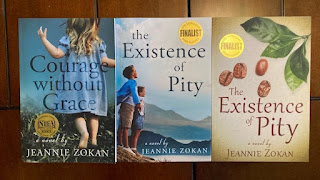
The event came days after I received a shipment of The Existence of Pity. I was expecting the original coffee bean cover my first paperback came in. and which I love dearly, but was thrilled Red Adept Publishing upgraded it to the new cover! 

The coffee bean cover is now a classic collectible, so hang onto it if you have one of them -- or trade it in for the new and improved version.

Diane's book, A Literary Traveler's Guide to the Gulf South, is a literary tour guide to the area. Together with wit and humor, beautiful photos and interesting sidebars, she leads readers on a delightful, yet educational romp along the gulf coast. It can be found on Amazon, or maybe you'll find us at another market, selling our books. 


We had so much fun we want to do it again, and we'd love to see you out there!


Sunday, October 2, 2022

Feel-Good Book 11: No Mud, No Lotus

There are some wonderful titles for books on Buddhism, such as Being Nobody, Going Nowhere by Ayya Khema; Wherever You Go, There You Are by Jon Kabat-Zinn, Chop Wood, Carry Water by Rick Fields, and this one: No Mud, No Lotus, by Thich Nhat Hanh. Like the other titles, this one can teach us. "Most people are afraid of suffering," the bestselling author writes in No Mud, No Lotus; The Art of Transforming Suffering. "But suffering is a kind of mud to help the lotus flower of happiness grow. There can be no lotus flower without the mud."
I borrowed this handbook from the local library, but I've read other books by the venerable Vietnamese monk, and have heard recordings he has made in his calm, soothing voice. He introduced the world to mindfulness, the state of awareness that brings peace, joy, and clarity to the present moment.
Researching for this blog I learned he also used calligraphy as a form of meditation, and his simple print and thoughtful quotes have me obsessed. I've already ordered a book full of his art and have copied some of his quotes. 

"This moment is full of wonders."

"A cloud never dies."

"We are already what we want to become."

"Do not run anymore you look silly." Haha! 

I've tried to recreate his calligraphy, but I don't have high hopes. My second-grade teacher predicted I'd never have nice handwriting, being left-handed and all, but that's not what counts here. 

Back to No Mud, No Lotus. One of over 100 books by Thich Nhat Hanh, this book is an easy, comforting read. He makes mindfulness seem so simple. "The way we start producing the medicine of mindfulness is by stopping and taking a conscious breath, giving our complete attention to our in-breath and our out-breath. When we stop and take a breath in this way, we unite body and mind and come back home to ourselves."

He uses a light approach to suffering that acknowledges pain and eases it."Breathing in, I know suffering is there. Breathing out, I say hello to my suffering." And for a dose of hope, "If you want to experience what the end of suffering will feel like, it is in the here and the now with this breath. If you want nirvana, it's right here. Breathing in, I know I am breathing in. Breathing out, I smile."

Thich Nhat Hanh shares a life-transforming Buddhist teaching that uses arrows as its metaphor. If you are hit by an arrow, you will feel pain. But if a second arrow hits in the same place, that pain will more than double the first. Consider the first arrow as something negative that happens to you -- failing a test, losing something valuable, getting sick, or being rejected. Then... "The second arrow, fired by our own selves, is our reaction, our story-line, and our anxiety. All these things magnify the suffering."

I catch myself time and again reliving something painful; in essence, firing a second arrow where the first one hit. Now I know to STOP, acknowledge the suffering, come back to the present moment and breathe. Oftentimes, we block our happiness by our desires. "We believe these things are necessary for our survival, our security, and our happiness. But many of these things - or more precisely our beliefs about their utter necessity - are really obstacles for our joy and happiness."

"If you come to look deeply into your fearful attachment, you will realize that it is in fact the very obstacle to your joy and happiness. Letting go takes a lot of courage sometimes. But once you let go, happiness comes very quickly."

"Just as we may have many small sorrows that mindfulness can help us release, we also have a multitude of small moments of happiness that we can savor and extend." Create happiness by enjoying the moment. "This is the art of happiness, tasting and delighting in the little happinesses of daily life." The monk suggests taking a piece of a paper and writing down all the conditions for happiness available to us right now. "One page may not be enough," he adds.

Thich Nhat Hanh passed away earlier this year at the age of 95, but he has left behind a large treasure of teachings, hope, and good humor. I've taken to wearing a bracelet that, every time I become aware of it on my wrist, I breathe and smile. It's just a simple way to become more mindful. If you'd like to go a step further and purchase Thich Nhat Hanh's calligraphy, "One Buddha is not enough" is on sale on Etsy for $24,500.

Tuesday, September 20, 2022

Feel-Good Book 10: The Journey Home

The Journey Home: Autobiography of an American Swami by Radhanath Swami is the reason for my desire to discuss books that guide me to higher understanding--and yet it has been the hardest one to write about. To refresh my memory, I started reading Swami's story again and it offers so much it was as if I hadn't read it at all. Sigh. Radhanath Swami has written a deep, thoughtful, heartfelt book with great wisdom and amazing stories, and all I can do is shine a flashlight on the vast night sky that is the wonder of this book.

Even as a boy growing up in Chicago, Radhanath Swami (born Richard Slavin in 1950) is different from others. Shy, reserved, and unusually compassionate, he seems out of sync in his surroundings, but fully aware of his need to find his true self, his calling in life. He embraces the counterculture of the seventies and ends up traveling, at 19, to Europe and to India. He openly shares, in vivid detail, the memories of his life. It's clear from the beginning that he will stop at nothing to reach his goal. And when he becomes a renowned spiritual guide, he returns to us with this powerful story and its simple message: stay in contact with your creator.

I still can't quite believe he sits on a rock in the Ganges River every day for a month in solitary meditation, but he has a picture of it. He lives in Himalayan caves, eats only what is offered to him as a mendicant, and travels any way he can to meet great Indian saints, gurus, and yogis who inspire him. He writes heartbreaking letters to his family back home and, as the reader, you see his struggle--and imagine theirs.

Radhanath Swami is an incredibly brave man, and driven by the need to find his truth. He says, "I tend to compartmentalize my thoughts, saying, 'Now I'll think about the political situation. Now I'll feel appreciation for this wonderful life. Now I'll think about food.' But what if my appreciation, my love for a divine being, can float above the compartments?"

Twice he quotes the beautiful guru and Indian saint Anandamayi Ma: "All sorrow comes from the sense of I and mine. All sorrow is due to one's keeping apart from God. When you are with Him all pain disappears. There can be no security, no stability here. These are to be found in God alone. Whenever you possibly can, sustain the flow of the sacred Name. To repeat His Name is to be in His presence. If you associate with the Supreme Friend, He will reveal His true being to you." She also says, "When your mind becomes vacant, endeavor to fill it with the awareness of God and His contemplation."

Guru Babaji Maharaja says, "Love of God is the inherent nature of the soul and is dormant within everyone. Chanting God's name reawakens that love from within the heart. We should aspire to be the humble servants of the servant of the servant of the Lord." And, "Just serve every creature in God's creation with humility, respect, and love. Just sing the names of Rama and everything else will be attained."

He also meets Mother Teresa, who is cleaning a cooking pot at the time. When someone asks why she is doing this, she says, "Serving God and humanity is an honor, not a chore. Any type of service to God is a blessing. There is no high or low." When asked where she finds the strength, she answers, "All my strength comes from the Lord's Holy Names."

I'm the cleaner of cooking pots in my home (and grateful that Chris likes to cook!) so I've posted a little reminder over my sink. "Here Now" it says. I learned (on Tiktok, I'll admit) that a profound way to become aware of the present and to think of my Higher Power is to narrate what I'm doing, especially as I clean the dishes. Somehow, saying to myself, "Rinsing the coffee cup, watching a cardinal, pumping soap into my hands," brings me into the moment. It's an easy step from there to taking a deep breath and feeling the presence of my Higher Power.

I'll leave you with one last quote from Swami sitting on his rock in the Ganges with the hope that you'll consider delving into the book yourself. "Except for the birdsong, that evening the Ganges valley was still with an almost mythical silence. My mind floated, recalling how God had taken from me so little and given me so much. For a moment I contemplated that to the degree one feels unworthy of grace, one will be grateful when it comes. It is gratitude that makes the heart receptive to receive the Lord's blessings. Closing my eyes, I merged again in the endless chant of Om, the river's song. It was just so beautiful."

Saturday, August 27, 2022

Feel-Good Book 9: Holy Cow!

I found this gem on audio at my local library and loved it so much I bought the book version to read again, and to dog-ear some pages. Holy Cow, published in 2002, is the story of Australian reported Sarah Macdonald who follows her fiance Jonathan Harley, also a writer, to India for six months. It becomes a two-and-a-half-year quest for inner peace.

When she begins with having her palm read, I knew I'd love the book. (In Courage Without Grace, my main character is a palm reader.) Although Holy Cow is beautifully written, full of humor and wit and thoughtful observations, it is not for the squeamish. Macdonald describes with unflinching detail the crowds (one billion and counting in an area about one third the size of the States), the pollution, the begging, and what seems to be ever-present death. This ugliness seems to be India's strength. When Macdonald sees how happy its people are, a man explains that Indians see those who have a harder life than they do and are grateful, thanking God for what they have. But we Westerners look at the people above us and think, why don't I have what they have? This constant comparison creates our unhappiness. Hmmm...

"India is beyond statement, for anything you say, the opposite is also true," Macdonald says. "It's rich and poor, spiritual and material, cruel and kind, angry but peaceful, ugly and beautiful, and smart but stupid. It's all the extremes."

When Macdonald goes on a silent meditation retreat for ten days, she describes it in her usual candid way, as a "brain enema." This is Vipassana, an ancient Buddhist training technique, and one of its theories states that, "Unconscious thoughts create physical sensations, so letting sensations arise and pass without reacting gets rid of unconscious pollutants within our mind." For the first few days, she is overwhelmed by the silence, the aches and pains, and her restless mind, but by the end she says, "I skip out the gates, down the hill and back into India on air. My mind is clear, my heart is open, everyone is beautiful, everyone is worth loving, the world is wonderful and I feel universal love and compassion for all. For the first time in my life I'm living in the moment and I no longer miss my job, perhaps because my need for outward success to feed the ego has diminished."

Alas, she doesn't maintain the euphoria, and her quest continues as she learns about Islam, Hinduism, Sufism, American Sikhs, Hare Krishnas, Jainism, Judaism, Indian Christianity, and Parsi Zoroastrians, who "leave out their dead for vultures believing it's the cleanest, most hygienic way of getting rid of the soul's temporary home."

"I've made a start in India along my path to personal transformation and inner peace. "The Sikhs have shown me how to be strong, the Vipassana course taught me how to calm my mind, India's Muslims have shown me the meaning of surrender and sacrifice, and the Hindus have illustrated an infinite number of ways to the divine."

And yet, after all her seeking, she adds, "A phrase from the Dalai Lama's teachings comes back to me; 'Some will be drawn to Buddhism but I really think it's best that you try and find truth in the religion of your forebears and ancestors. It is very hard to change religion. I think it's safer not to.'"

Some may say I've left out the best aspect of this book: the people Macdonald meets as she travels all over India in this rollicking adventure. Oh, and the part where her now-husband Jonathan is in Afghanistan--and it's September 11, 2001. There's something in this book for everyone, and what speaks to me is her spiritual journey.

"I've learned much from the land of many gods and many ways to worship. From Buddhism the power to begin to manage my mind, from Jainism the desire to make peace in all aspects of life, while Islam has taught me to desire goodness and to let go of that which cannot be controlled. I thank Judaism for teaching me the power of transcendence in rituals and the Sufis for affirming my ability to find answers within and reconnecting me to the power of music. Here's to the Parsis for teaching me that nature must be touched lightly, and the Sikhs for the importance of spiritual strength. I thank the gurus for trying to pierce my ego armor and my girlfriends for making me laugh. And most of all, I thank Hinduism for showing me that there are millions of paths to the divine."

Saturday, August 13, 2022

What I'm Reading: Feel-Good Book Eight

Bestselling author Dr. Joe Dispenza says 95% of the thoughts we have today are the same ones we had yesterday, and he wants to make sure our thoughts are helping us move forward, not holding us back.

I bought a hardback copy of Becoming Supernatural: How Common People Are Doing the Uncommon from Amazon because my friend Julie insisted I read it. It's a cerebral book, and my brain hurt from the effort of understanding it, but I certainly learned a lot. Dispenza, who's mantra is "Where attention goes, energy flows," opened my eyes to the scientifically proven importance of thinking positive thoughts. He says, "How you think and how you feel literally creates your personal reality." 

"So if you want to create change, you have to do it from a level of energy that's greater than guilt, greater than pain, greater than fear, greater than anger, greater than shame, and greater than unworthiness. In fact, any lower-vibrational energy that you are feeling cannot carry the thought of your future dream. If you are going to perform something that's unlimited, you'd better feel unlimited. If you want to create freedom, you'd better feel free. And if you want to truly heal yourself, you'd better raise your energy to wholeness."

I appreciate that Dr. D has been able to track and explain the power of maintaining positive emotions, but for the life of me I wasn't able to feel unlimited last weekend. Chris and I visited family in Atlanta and we packed a month's worth of activities into three days. Somehow everything worked out, even the trip to the DMV, and we had a wonderful time. But there was definitely some lower-vibrational energy going on, mainly fear as Chris and my brave daughter maneuvered the Atlanta highways.

When Dispenza says, "You have to think greater than the way you feel to make any real, lasting changes," he adds great advice. An excellent way to level up is to look around for something - anything - to feel grateful for, like a beautiful red rose or a purring black cat. 

Another way is the following chakra meditation.

"Begin by placing your attention in the first energy center (the root chakra at the base of the spine), and then move to opening up your attention to the space around this center. Once you can sense this space around the energy center, bless that center for the greatest good, and then connect to elevated emotions --like love, gratitude or joy--to raise the frequency of this center and also create a coherent field of energy. Do this for each of the seven energy centers in the body, and when you come to the eighth center, a place about 16 inches above your head, bless this center with gratitude or appreciation or thankfulness, because gratitude is the ultimate state of receivership.

"Remember: the more powerful your feelings, the more you are up-regulating your own genes. Bless your body, bless your life, bless your soul, bless your future as well as your past, bless the challenges in your life, and bless the intelligence within you that is giving you life."


Here's what "up-regulates" me. Appreciation for my family and ancestors, dear friends, pets, my good health, my house, my books, the beach, morning tea, etc. I'm also grateful for the things that make me laugh. On those days when I can'ts seem to find my way out of fear (or Atlanta), I look back on the happy times I've collected, thanks to Jeanne Robertson. Those funny moments continue to delight, and as a result, my personal reality becomes a place of joy.

Thursday, July 14, 2022

What I'm Reading: Feel-Good Book Seven

I'm shifting gears to a lighter kind of enlightenment with this book. I borrowed Humor: The Magic of Genie by Jeanne Robertson from the shelves of the Emerald Coast Writers conference room in Pensacola. I've been a member of The Emerald Coast Writers (formerly the West Florida Literary Federation) since 2006, and highly recommend this group to anyone wanting to write -- or to borrow books from their library. 

In this book, published in 1990, humorist Jeanne Robertson, who "grew up large in a small Southern town," shares "Seven Potions for Developing a Sense of Humor" along with plenty of anecdotes from her life as a 6'-2" beauty pageant winner turned professional speaker What a fun, uplifting experience it was to read her book and learn more about her!

My sweet mother loved to laugh, and I remember many funny times with her. Robertson also had a mother with a great sense of humor. Speaking about her mom, she writes, "Standing proudly by my waist [Robertson reached 6'2" at 13], she would say to the salesclerk, 'I want to get some things here for the baby,' and lovingly glance all the way up at me. Once a clerk asked, 'What size shoe does the baby wear?' ... 'She wears a seven and a half, but an eleven feels reeeeal gooood if you happen to have any.'"

Many of Robertson's anecdotes center around her height and her speaking engagements. Once, the contact for a group in Michigan told her, "Everybody is looking forward to looking up to you." She told him she looked forward to speaking at the banquet, and he answered, "As a matter of fact, when you get here you really don't have to be so funny ... but you darn well better be tall!"


She also speaks of her son Beaver (6' 8"), who came by his nickname, as an infant from Red Ryder's faithful sidekick. Once, before Beaver was old enough to wear braces to straighten his teeth, the family went to a restaurant. Robertson writes, "I am like most mothers -- I give directions. 'Put your coat on that hook, Beaver.' 'Sit in that chair, Beaver.' 'Here's the menu. What do you want to order, Beaver?' All of the sudden, a woman at the next table grabbed me by the arm and said, 'How would you like it if he called you giraffe?'"

Excellent advice from this book: develop humor awareness by looking for humor in everyday situations; create your own humor; associate with humorous people, or just ask others to tell you something funny; and collect happy times.

Gretchen Rubin, best-selling author of The Happiness Project, points out, "One of the best ways to make ourselves happy in the present is to recall happy times from the past. Photos are a great memory-prompt, and because we tend to take photos of happy occasions, they weight our memories to the good." 

I have set out on a quest to collect happy times, like the moment of pure joy I captured of my mom. One of the reasons I love working at Hallmark is because of the funny cards, like this one of a dog saying, "I did not get you a car for your birthday." Inside, it reads, "It's a long story and I'd rather not talk about it." For the life of me I don't know why it's so funny, but it gets me every time!

A quick note about my book, Courage Without Grace. The stickers are in! Chris and I made this video, in hopes that it would give someone a laugh!